 Pinnacle Workforce Consulting
Insight · Classification & Compensation
Classification Audit Readiness: A 5-Point Gap Check
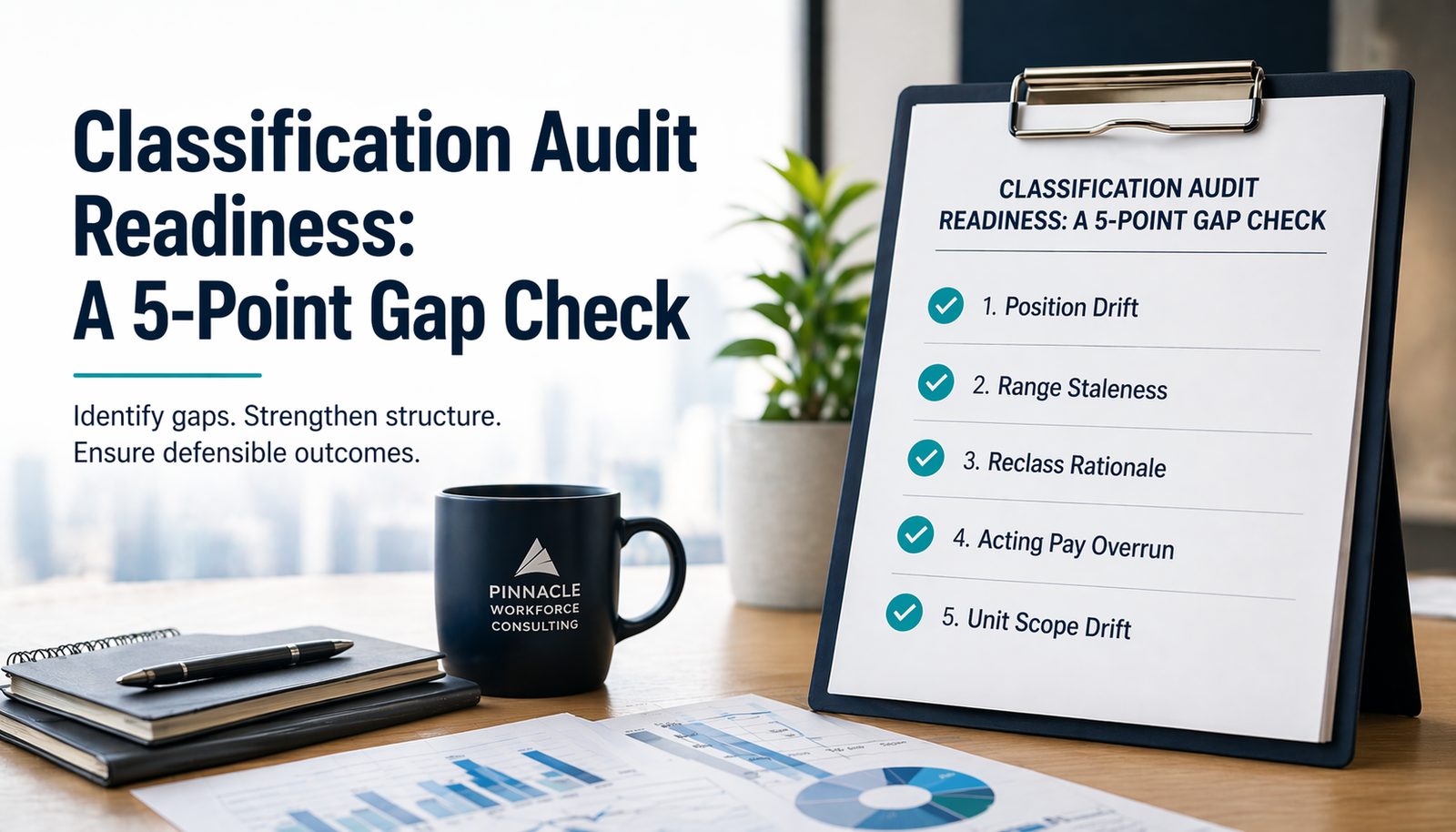
Most classification audits fail in the same five places. The problems are not exotic. They are the compounding result of decisions made under pressure, documented lightly, and never revisited. Here is how to diagnose them before an auditor, an arbitrator, or a legislator does it for you.
1. Position descriptions do not match the actual work
The single most common finding. A job description written in 2017 is being used to justify a 2026 pay grade, while the employee has absorbed three new responsibilities, shed two old ones, and reports to a function that no longer exists in the same form. If a desk audit happens tomorrow, the written description will not support the grade assignment.
Gap check: pull 20 positions at random. Ask each incumbent to describe their week in writing. Compare the descriptions line by line. Any position with more than a 30 percent work-content delta needs a current review.
2. Pay ranges have not been anchored to external comparators in 3+ years
Labor markets move. Comparator data from 2022 does not defend a grade decision in 2026. When ranges drift from the market, two things happen: retention problems on the high side and grievance exposure on the low side. Both are expensive and both are avoidable.
Gap check: identify your three most litigated or most volatile classifications. Pull fresh comparator data from at least two independent sources. If the midpoint gap is 5 percent or more in either direction, the range needs a formal review.
3. Reclass decisions lack documented rationale
A reclassification that cannot be defended in writing is a grievance waiting for a sponsor. Auditors and arbitrators do not care what the manager said verbally in 2023. They care what is in the personnel file. If the rationale is a single sentence, that is a finding. If it references factors that were not actually measured, that is a bigger finding.
Gap check: select every reclass completed in the last 24 months. Confirm each includes a written factor-by-factor analysis that ties to the classification standard. Missing documentation is a red flag you still have time to fix.
4. Temporary and acting pay has run past its allowed duration
Most merit systems cap temporary and acting assignments at a specific duration, after which the position must either be filled permanently or the pay must end. It is easy to let these drift. It is also one of the faster ways to generate a personnel grievance or a state-auditor citation.
Gap check: run a report of every employee currently receiving acting or temporary differential. Flag any assignment beyond the policy limit. Close out or regularize immediately. Do not wait for the audit.
5. Bargaining unit scope has drifted
When duties change, unit placement sometimes needs to change with them. If a position moves from a non-exempt unit to a supervisory role and the classification does not follow, you are exposed on two fronts: an unfair labor practice charge and a grievance from the losing unit. The drift usually happens quietly, one reclass at a time.
Gap check: review reclass and promotion decisions from the last 18 months. Confirm each one correctly affirmed or updated bargaining unit placement. Document the analysis even when the unit did not change.
What to do this quarter
You do not need an external consultant to run the five gap checks above. What you need is discipline. Pick one check per month. Document what you find. Assign a corrective action with a deadline. Report the closeout to leadership so the finding does not drift back open.
If the volume of findings exceeds what your team can fix internally, that is the right moment to bring in outside advisory support. The wrong moment is after the auditor has already cited you.
Need a second set of eyes on your classification posture?
A focused Workforce Diagnostic delivers a written findings report and prioritized remediation plan in 4 to 6 weeks. Fixed scope, executive briefing.
Start a conversation